What is Headless Commerce?
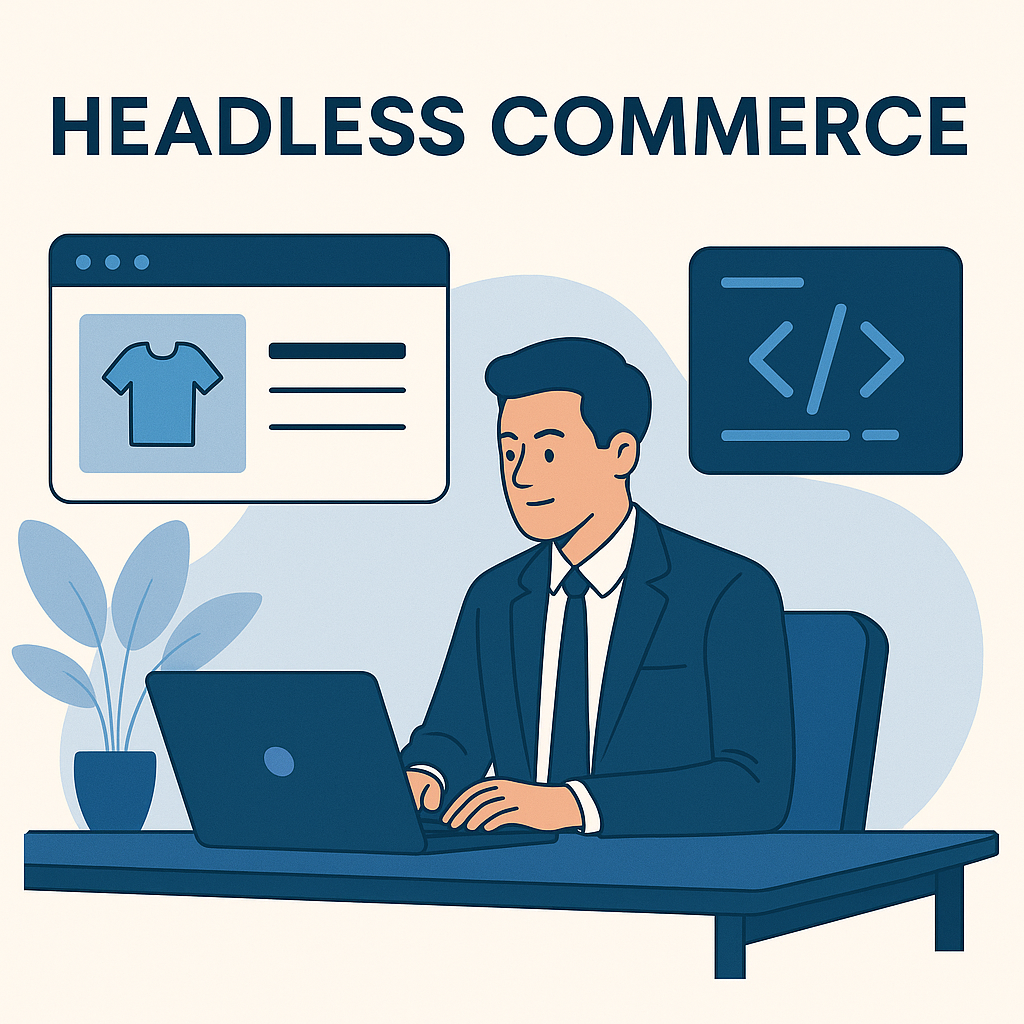
At its core, headless commerce means your storefront and your backend are no longer glued together.
In a traditional eCommerce setup, think a standard Shopify or Magento site the part your customers see (the frontend) and the part that manages your products, orders, and inventory (the backend) are tightly connected. Change one, and you risk affecting the other. Want to redesign your product pages? You’re working within the limits of whatever your platform allows.
Headless commerce cuts that connection. The frontend and backend talk to each other through APIs, but they operate independently. That means your developers can build any kind of customer experience they want on any device, through any channel without touching your core commerce system.
Your product catalog, pricing, inventory, and orders all live safely in the backend. The frontend is free to be whatever your brand needs it to be.
A Simple Way to Think About It
Imagine a restaurant.
In a traditional setup, the kitchen and the dining area are deeply connected. Renovating one often means disrupting the other. But what if they could operate completely independently? The kitchen keeps producing great food regardless of what’s happening out front, and the dining team can redesign the space, add new seating, or even open a takeaway counter all without touching the kitchen at all.
That’s headless commerce. Your backend (the kitchen) keeps running your business. Your frontend (the dining area) has the freedom to evolve, experiment, and improve without anything breaking underneath.
A typical headless setup includes four parts:
- The frontend – your website, mobile app, PWA, or any customer-facing interface
- The API layer – the bridge that lets frontend and backend talk to each other
- The backend – product catalog, inventory, payments, orders, customer data
- A headless CMS – manages your content (blogs, banners, landing pages) independently from the commerce platform
Headless vs. Traditional: What's Actually Different?
|
Feature
|
Traditional Commerce
|
Headless Commerce
|
|
Architecture
|
Frontend and backend are locked together
|
They work independently
|
|
Design flexibility
|
You’re limited by platform templates
|
Complete creative freedom
|
|
Page speed
|
Often constrained by the platform
|
Optimized with modern frameworks
|
|
Making updates
|
Slow changes can break things
|
Fast and low-risk
|
|
Selling across channels
|
Complicated
|
One backend, many frontends
|
|
Scalability
|
Needs platform upgrades
|
Scale each layer independently
|
|
Tech stack
|
Locked in
|
Choose what works best for you
|
Traditional platforms aren’t bad; they’re still a solid choice for smaller stores with straightforward needs. But if you’re growing fast, selling across multiple channels, or trying to deliver experiences that stand out, you’ll hit the ceiling of a monolithic platform sooner than you’d expect.
Why More Businesses Are Making the Switch
1. Speed and What It Does for Your Rankings
Slow websites lose sales. That’s not an opinion, it’s a measurable fact. And in 2026, Google’s Core Web Vitals (the metrics that measure real-world page experience) are a direct ranking factor.
Because the frontend in a headless setup is built independently typically with frameworks like Next.js developers can optimize it aggressively for speed. Pages can be server-side rendered or statically generated, which means faster load times, better Core Web Vitals scores, and ultimately, better visibility on Google.
As a bonus, since your CMS is decoupled from your commerce platform, your content team can publish and update pages without any risk of slowing down the storefront.
2. You’re Not Stuck with Someone Else’s Templates
Every brand wants to be distinctive. But when you’re building on a traditional platform, you’re always working within guardrails templates, theme limitations, plugin conflicts.
With headless commerce, your developers use tools like React, Next.js, or Vue.js to build exactly what your brand needs. No compromises. Brands like Nike rebuilt their frontend using headless architecture to deliver a faster, more immersive global experience. Lancôme used it to launch AR-powered virtual try-ons, something a traditional platform simply couldn’t support.
3. Selling Everywhere Gets a Lot Easier
Your customers aren’t just on your website. They’re browsing Instagram, shopping on marketplaces, using mobile apps, and increasingly interacting through voice and smart devices. Managing all of that from a traditional platform means stitching together a fragile mess of integrations.
Headless commerce flips this. One backend powers everything. Your product data, pricing, and inventory stay consistent across every channel, while each frontend is optimized for its specific context. It’s a much cleaner way to run an omnichannel business.
4. Real Personalization Not Just “Hi [First Name]”
True personalization is more than inserting someone’s name into an email. It’s about tailoring the entire shopping experience based on who someone is, what they’ve bought before, and what they’re likely to want next.
Headless commerce makes this possible by integrating cleanly with personalization tools like Segment or Klaviyo. Because the frontend is decoupled, you can run A/B tests, swap out layouts for different customer segments, and surface different products all without touching the backend. And since all your customer data flows into one system, your retargeting, lifecycle campaigns, and on-site recommendations actually work together.
5. It Scales With You
Growing businesses break traditional platforms. Traffic spikes, new markets, new product lines these things require infrastructure that can flex without a full rebuild.
With headless commerce, you scale the frontend and backend independently. Add a new sales channel without rebuilding your product catalog. Handle a seasonal traffic surge without a platform migration. It’s a much more sustainable way to grow.
The Tech Stack Behind It All
Part of what makes headless commerce so flexible is the technology that powers it.
Common frontend frameworks: React, Next.js, Vue.js, Angular
Popular backend platforms: Shopify Plus, Adobe Commerce (Magento), BigCommerce, CommerceTools
Headless CMS options: Contentful, Strapi, Sanity
API standards: REST APIs and GraphQL
This approach is often called MACH architecture Microservices, API-first, Cloud-native, Headless. It’s the foundation of what’s now known as composable commerce: instead of buying into one all-in-one platform, you assemble the best tools for each job and connect them through APIs. Best-in-class search. Best-in-class payments. Best-in-class personalization. All working together, all replaceable individually if something better comes along.
AI Is Making Headless Commerce Even More Powerful
One of the biggest advantages of headless architecture right now is how easily it integrates with AI tools.
Businesses are using AI to power:
- Product recommendations that adapt to each shopper’s behavior
- Intelligent search that understands intent, not just keywords
- AI chatbots for real-time customer support
- Dynamic pricing that adjusts based on demand
- Inventory forecasting to reduce stockouts and waste
- Customer behavior analysis to spot churn risks before they leave
Because the frontend and backend are decoupled, plugging in a new AI tool doesn’t require rebuilding your platform. You integrate it, connect it via API, and it works. As AI capabilities continue to evolve and they’re evolving fast this flexibility is going to be a significant competitive advantage.
Why Indian Businesses Are Particularly Well-Positioned for This
India’s eCommerce market is one of the most dynamic in the world right now, and headless commerce addresses some of its most specific challenges.
With over 900 million smartphone users, mobile-first isn’t a preference here, it’s the baseline. Headless commerce enables Progressive Web Apps (PWAs) that load fast even on slower connections, behave like native apps, and don’t require users to visit an App Store.
Beyond mobile, there’s the complexity of India’s market itself: multiple languages, fragmented payment preferences (UPI, wallets, BNPL, COD), and dramatically different customer behaviors across metro and Tier 2/3 cities. A decoupled frontend makes it far easier to build localized experiences for different audiences without managing multiple backends.
Add to that the growing base of skilled Indian developers who work with React and Next.js, and the cost-to-value ratio for building headless in India is genuinely hard to beat.
Is Headless Commerce Right for You?
Honestly? It depends on where you are and where you’re headed.
Headless is a great fit if you:
- Need a storefront that looks and feels distinctly yours
- Sell across multiple channels or plan to
- Are growing fast and need infrastructure that keeps up
- Care about page speed and SEO performance
- Want to integrate AI, personalization tools, or custom features
- Are planning international expansion
It might be more than you need right now if:
- You’re running a small store with a simple catalog
- Customization isn’t a priority
- You don’t have the development resources to manage a more complex architecture
There’s no shame in sticking with a traditional platform if it genuinely serves your needs. But if you’re hitting ceilings in design, performance, or scale headless commerce is worth a serious look.
How Apro Can Help
At Apro IT Solutions, we’ve helped businesses across India build eCommerce experiences that actually perform not just look good in a demo.
We work across custom eCommerce development, headless commerce architecture, API integrations, UI/UX design, and mobile commerce. We don’t push a one-size-fits-all solution, we start by understanding your business, your customers, and your growth goals, and then recommend what actually makes sense.
If you’re curious about whether headless commerce is the right move for your store, we’re happy to walk you through it.
Wrapping Up
Headless commerce isn’t about technology for technology’s sake. It’s about removing the constraints that slow your business down and giving your team the freedom to build experiences your customers actually love.
In 2026, the gap between brands that invested in flexible, fast, personalized eCommerce and those that didn’t is becoming very visible. The good news is it’s not too late to get ahead of it.
Whether you’re just starting to explore headless commerce or ready to start building, the most important step is understanding what your business actually needs and making sure the technology serves that, not the other way around.
Frequently Asked Questions
Is headless commerce better for SEO?
Yes, when done right. Faster load times, improved Core Web Vitals, and flexible frontend frameworks like Next.js contribute directly to better search performance.
Which businesses benefit most from headless commerce?
Growing businesses, omnichannel retailers, enterprise brands, and companies that need customized digital experiences tend to get the most out of it.
What technologies are commonly used?
On the frontend: React, Next.js, Vue.js. On the backend: Shopify Plus, Adobe Commerce, BigCommerce, CommerceTools. For content: Contentful, Strapi, Sanity. APIs are typically REST or GraphQL.
How does headless commerce support AI?
Because the layers are decoupled, AI tools for personalization, search, chatbots, and dynamic pricing can be integrated without rebuilding the platform – making it much easier to adopt new capabilities as they emerge.