3 min read
 3 min
01 · 1 MIN READ
What you’re actually paying for
Every app project has the same five stages. The cost is spread across all of them, not just development.
- Discovery: working out what the app must do, for whom, and what can wait
- UX and UI design: screens, user flows and the visual system
- Development: the app itself, plus the backend and an admin panel to manage it
- Testing: on real devices, across screen sizes and operating system versions
- Release: App Store and Play Store submission and approval
A quote that only prices development is missing at least half the project.
02 · 1 MIN READ
Typical price ranges
These are typical ranges for 2026. Your final cost depends on scope.
- MVP or simple app: ₹2–5 lakh. A focused first version with the core features only.
- Mid-size app: ₹5–10 lakh. User accounts, payments, notifications and an admin panel.
- Complex app: ₹12 lakh upwards. Multiple user types, real-time features, or integrations with other systems.
These ranges assume one app for both Android and iOS, built from a single cross-platform codebase.
03 · 1 MIN READ
What pushes the cost up
- Platforms. Two separate native apps cost more than one cross-platform build.
- Features. Payments, maps, chat and live tracking each add design, build and testing time.
- The backend. Most of an app’s work is invisible: the servers, data and admin tools behind it.
- Integrations. Connecting to your ERP, CRM or payment gateway adds complexity.
- Design depth. Custom illustrations and animation take longer than standard components.
04 · 1 MIN READ
Why starting with an MVP saves money
An MVP, or minimum viable product, is the smallest version of your app that solves the main problem well. You launch it, watch how people use it, and only then build more.
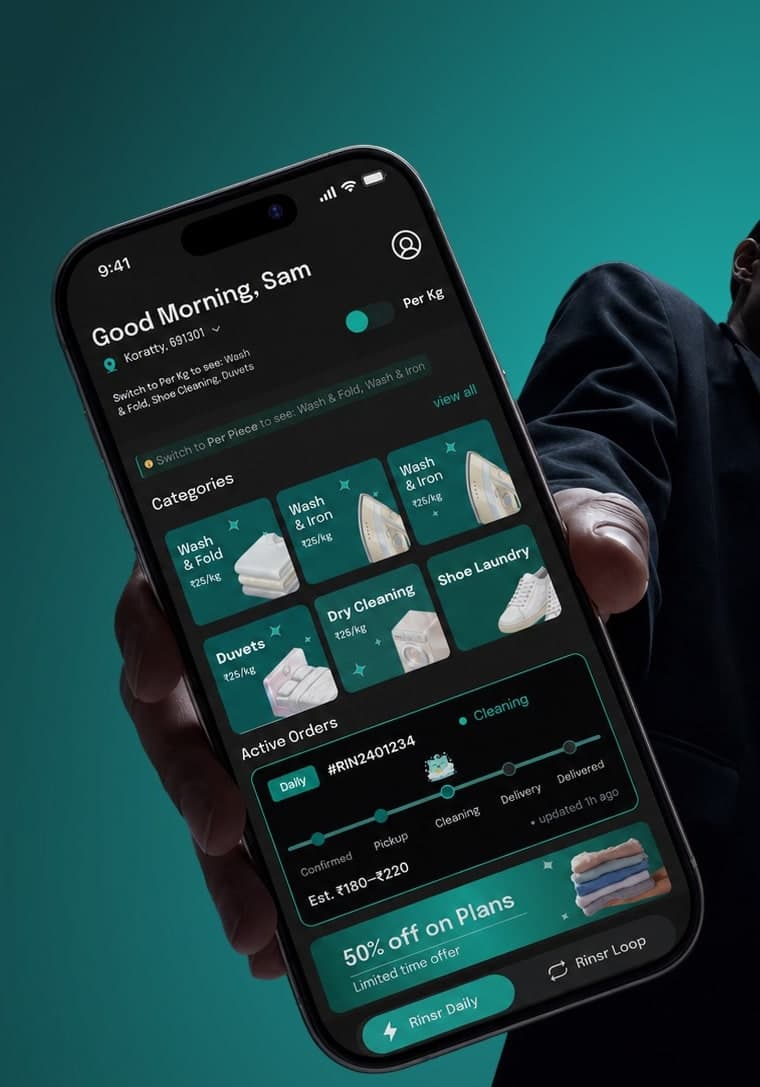
That’s how we approached RINSR, a laundry booking app in its pilot stage. Instead of building every feature, we focused on one problem: customers didn’t trust the price. The fix was simple. Users choose a rough quantity rather than an exact weight, and see an honest price range before they book. The result: two to three times more people now finish a booking, and drop-offs fell by half.
One problem solved well beats twenty features solved badly.
05 · 1 MIN READ
The costs after launch
Launch is the start, not the end. Budget for:
- Developer accounts on the App Store and Play Store
- Hosting and backend services
- Updates for new iOS and Android versions
- Bug fixes and small improvements
- New features as you learn what users want
An app that isn’t maintained starts breaking within a year, usually on the newest phones first.
06 · 1 MIN READ
Questions to ask before you sign
- What exactly is in the first version, and what isn’t?
- Is the backend and admin panel included in the price?
- Will it be one cross-platform app or two native ones, and why?
- Who owns the code and the store accounts?
- What does maintenance cost after launch?
At Apro IT Solutions, every project starts with a written proposal covering scope, timeline and cost, and you own the code and documentation when it’s done. You can see how we approach mobile app development.
07 · 1 MIN READ
Build the version you need now
The most expensive app is the one built for users you don’t have yet.
Start small, learn fast, and spend the rest of the budget on what people actually use.
Planning an app? Tell us about your idea and we’ll send a written quote within one working day.