3 min read
 3 min
Every few weeks, someone claims SaaS is over. The argument is familiar: “Companies will use AI to build their own software, and the subscription model will collapse.”
I understand where this comes from, but I don’t think it’s right.
Software isn’t going anywhere. Your ERP, CRM, and core operational platforms will still exist in five years, and companies will still pay for them.
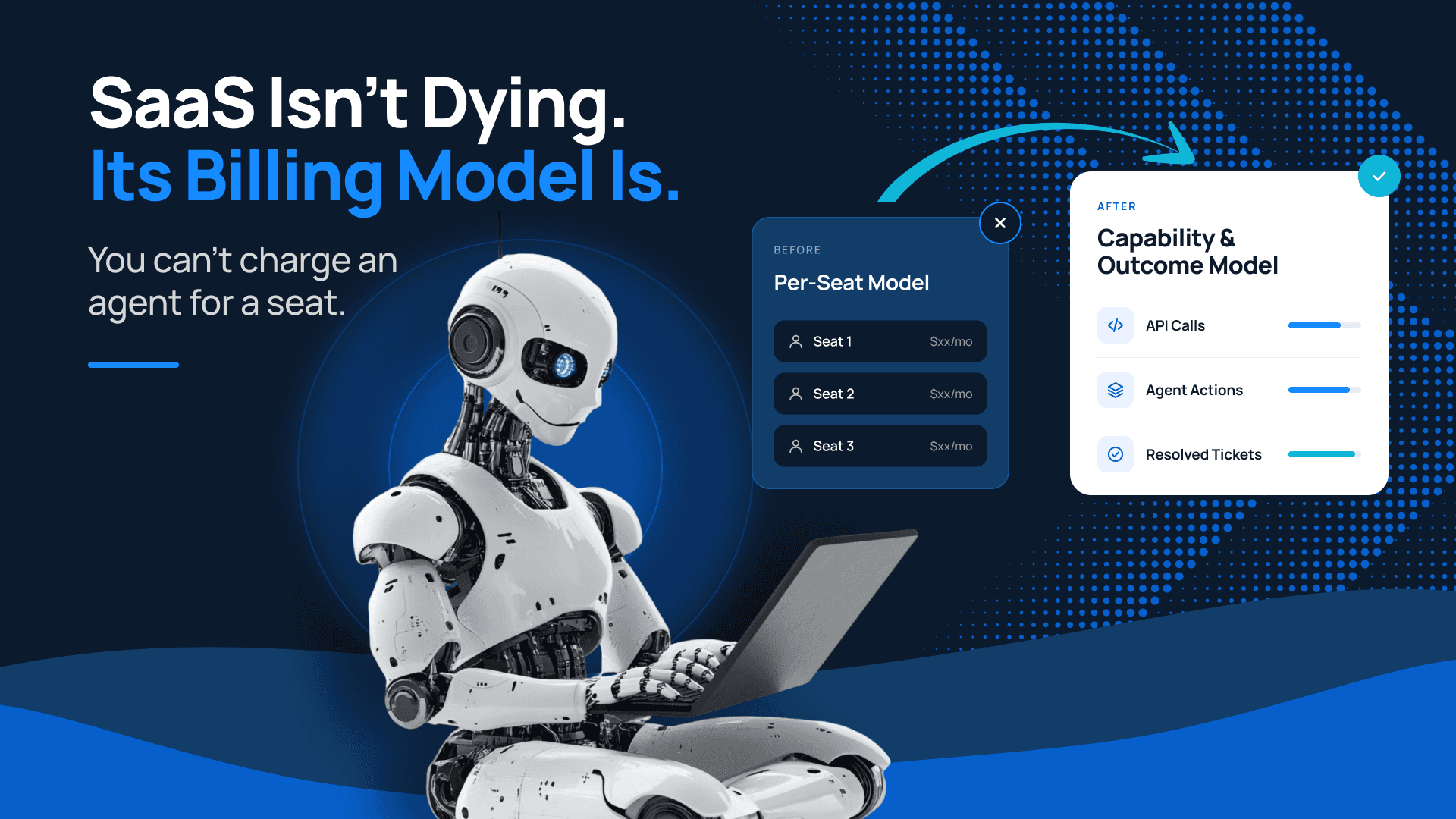
What is dying is the way we’ve priced most of it: a fixed monthly fee per seat, regardless of whether a user logs in daily or once a quarter.
The per-seat model worked when the primary user was a human behind a screen. That assumption is breaking, and most software infrastructure wasn’t built for what’s replacing it
01 · 1 MIN READ
Three Shifts Driving the Move Away From Seat-Based Pricing
The “end of SaaS” narrative conflates three distinct shifts:
- Building software got cheaper. AI coding tools allow internal teams to build lightweight tools in weeks instead of months. But building was never the real cost—running software is. Maintenance, compliance, security, and 2 a.m. uptime stay expensive. Companies will build thin internal tools, but they won’t rebuild their systems of record.
- The end-user is changing. More products are now called by autonomous AI agents, not human end-users. An agent doesn’t need a UI or a dashboard; it needs an API, clear function definitions, and machine-readable pricing. You can’t charge an agent for a seat.
- Serving a customer is no longer a flat cost. AI features incur real compute costs with every execution. One client can cost 50x more to serve than another on the exact same plan. Fixed per-seat pricing quietly turns your power users into your least profitable accounts.
Together, these trends force a shift from selling access to selling capabilities: a resolved support ticket, a scored lead, 1,000 API calls, or an hour of agent work.
02 · 1 MIN READ
How the Market Is Adapting
We are already seeing major platforms move toward capability- and outcome-based models:
- Salesforce transitioned Agentforce pricing to Flex Credits ($0.10 per agent action), replacing static conversation fees with per-action metering.
- Zendesk and Intercom moved toward outcome-based models, charging directly per autonomous resolution ($0.99 per resolution for Intercom’s Fin agent).
Most B2B platforms will settle on a hybrid architecture:
- Platform fee for base access and infrastructure.
- Usage credits to cover compute and variable work.
- Outcome tier for well-defined success metrics.
03 · 1 MIN READ
The Real Challenge: Underlying Infrastructure
Traditional seat billing answers one end-of-month question: How many accounts were active?
Capability-based models require real-time validation:
- Machine-readable catalogs: Agents need structured capability lists and pricing formats they can programmatically consume.
- Real-time rate limiting: Credit balances must be verified in milliseconds before executing compute. Running past limits means incurring compute costs you may never collect.
- Granular metering: Usage must be accurately tracked, mapped to contract tiers, and converted into clear financial reporting.
- Auditability: Buyers require line-item visibility into what triggered every compute charge.
When pricing logic is hardcoded into application code, every pricing iteration becomes a full dev sprint.
04 · 1 MIN READ
Outcome Pricing: Who Defines Success?
Outcome-based pricing is compelling, but its biggest hurdle is operational: who decides when work was successfully completed?
If a customer leaves a support chat without escalating, was the issue solved, or did they give up?
To make outcome pricing work without contract disputes:
- Define outcomes programmatically: Both parties agree on clear telemetry rules (e.g., a ticket is resolved if closed with no human intervention and not reopened within 72 hours).
- Expose raw event logs: System event streams (closed, escalated, reopened) must be fully verifiable by the client.
- Automate validation: Billing systems evaluate rules against telemetry event logs before finalizing charges.
When both seller and buyer share a single source of event data, billing moves from an ongoing negotiation to automated execution.
05 · 1 MIN READ
The Shift Is Already Underway
The transition away from seat-based pricing is already underway. Software isn’t disappearing; it’s shifting from static access to dynamic execution.
How is your team handling the transition toward usage- and agent-based pricing models?